253. Still life after Morandi (Stillleben nach Morandi)
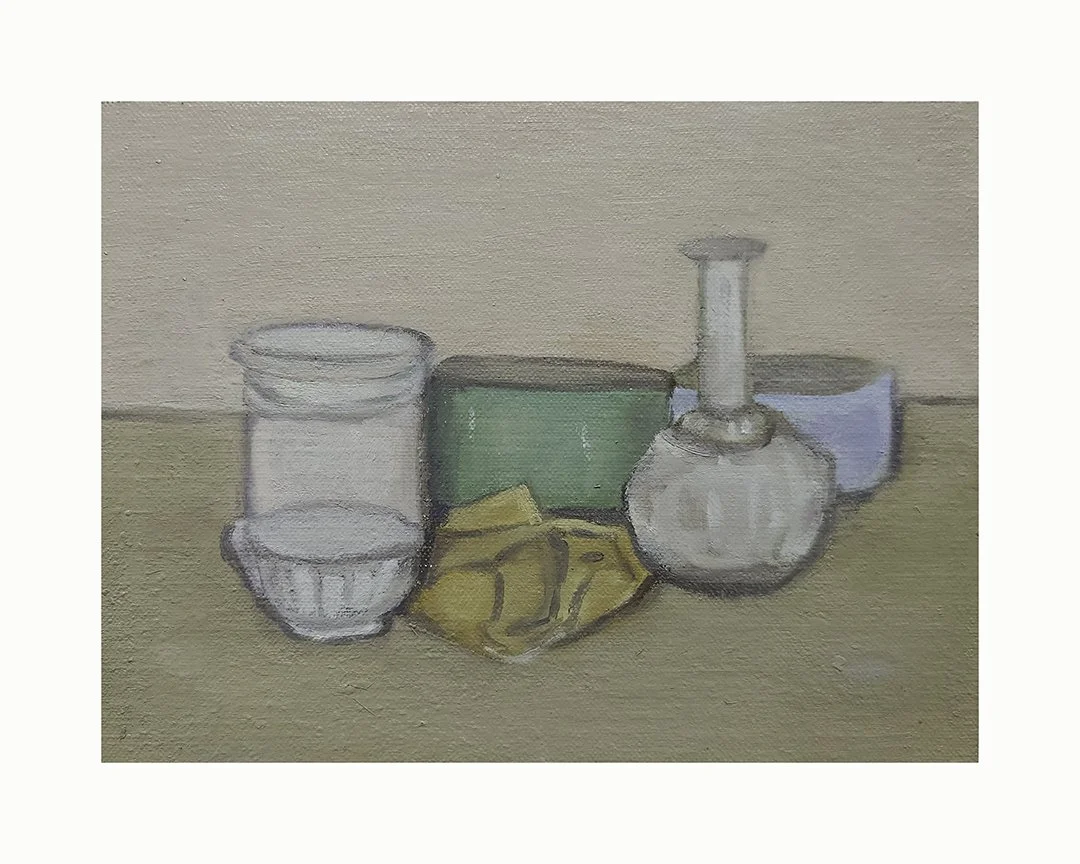
253. Still life after Morandi (Stillleben nach Morandi), 2026, Öl auf Leinwand, 15 × 20cm, (Thomas Ansted)
I am no Morandi expert so I can’t say much about the man. You probably know more about him than me. Suffice it to say there is simplicity to his work. The often-unusual shape of the vessels that Morandi collected and painted create shapes that defy typical visual perspective and take the painting away from exactitude and toward something else.
The unusual vessels are simply painted. Something ‘perspectival’ is put aside, however, something rectilinear is nonetheless brought forward in these paintings. The rectilinear organization of things makes it also very soothing to look at. Table goes across, Vessels go up and down. The wall and the table have a subtle complimentary agreement. Overall, copying it was an exercise in losing the line. It is always good to reorient toward, shape and color like this, and to develop the ‘color spaces’ that can be opened by painting.
I would say that there is something almost digital about these still lifes by Morandi (digital, from the Latin word digitus for finger/toe plus the suffix -alis meaning measured with fingers. More broadly ‘digital’ is when discrete numerical quanta follow one another, like steps in a staircase). The infinity that was present in the folds of fabric from last month was therefore left aside in this exercise with my class. In a simple way you could say Morandi’s painting is flatter, more like a product of the twentieth century, but he seems to be self-consciously developing this path.
In art history Morandi is always presented as painting under fascism and the class is often asked to write an essay about art and politics examining the case of Morandi. I try to free his ankle from the bear trap of these discussions these days. Let the man paint his vessels. But I am no Morandi expert so I can’t say much about the man.