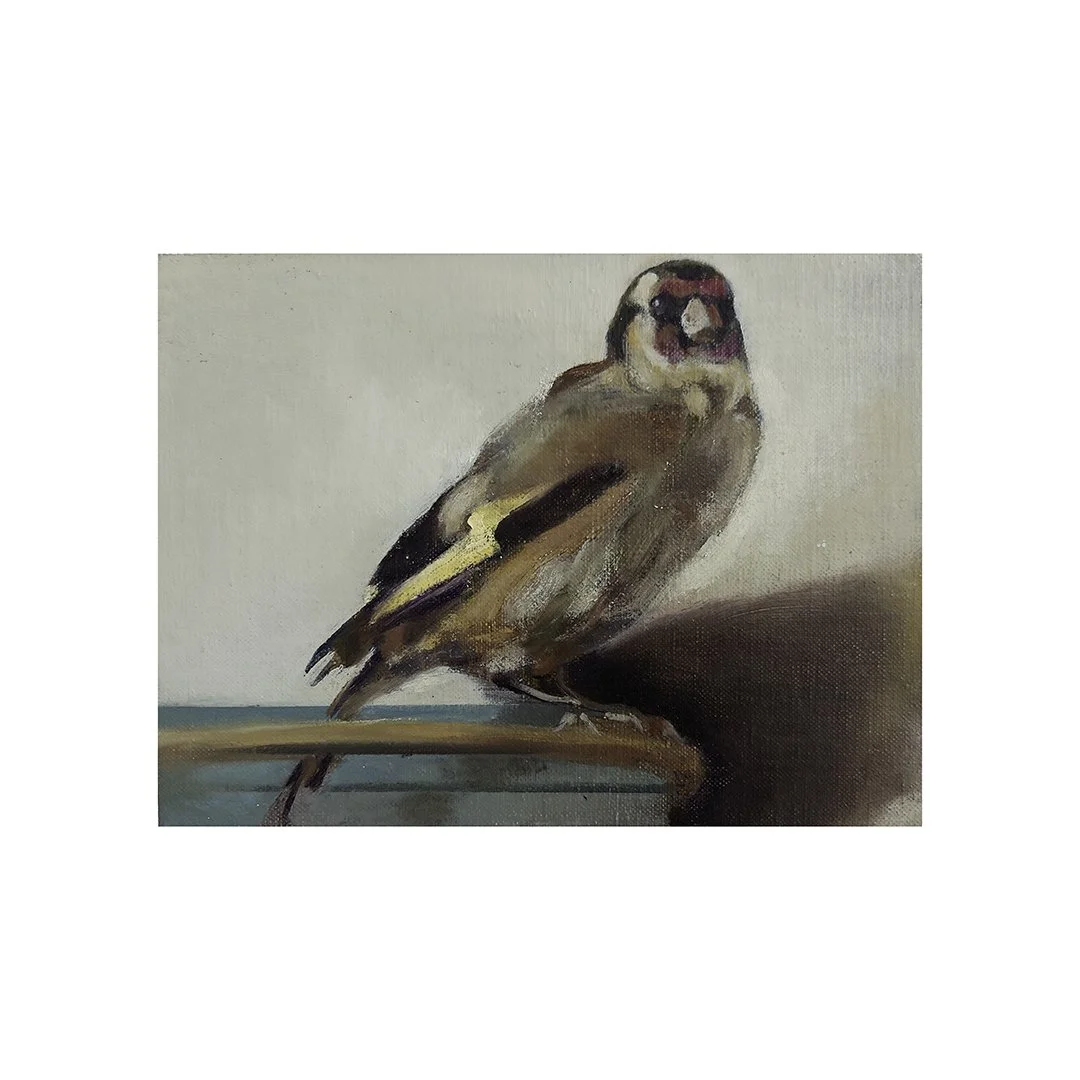
277. Still life after Fabritius (Stillleben nach Fabritius)[The Gold Finch (Der Distelfink)], 2026, Öl auf Leinwand, 20 × 15cm
I was extolling the virtues of the Gold Finch painting to someone in the gallery recently and afterward I thought maybe it could also be instructive for me to have a closer look at this painting. So I undertook this transcription of it, and indeed I have learned a lot.
It is a fascinating painting with a rich and interesting history that really should be read about separately. Central points to note are that Fabritius was sandwiched between enormously successful painters, his teacher was Rembrandt and his younger contemporary was Jan Vermeer, whom he influenced. Unlike them, Fabritius’ life was tragically cut short when an explosion near his studio caused it to collapse on him, and destroyed most of his work.
The Goldfinch painting itself is also worthy of attention and has a fascinating history. It portrays a captive bird, which is thought to have been placed in the window of a shop, possibly his own atelier. Nonetheless, despite the sad life of the bound bird, Fabritius paints it with unusual dignity. It seems to me that he approaches it like painting the portrait of a person. It makes quite a departure from the actual bird known as a gold finch (Carduelis carduelis). The yellow color of the wing for example becomes truly golden in the painting. The face too is painted with the mystique of an old Rembrandt self-portrait. The bird regards him painting it, and in such a way, taken together with its stance, that it makes me suspect that the bird may not have even been present. It might be that he painted it as a memorial to a bird that no longer kept him company. Perhaps that is not so unusual, given by this stage by age 32, he had lost his wife and all three children. He has eased the expression in the eyes, to make them more human and less stern than Gold Finches ordinarily appear. The list of subtle accentuations and omissions goes on. As I was painting my transcription of the bird, it seemed to have more feathers on the front. I felt like the bird was puffing its chest up toward me as I approached painting it. Certainly, it was a strange experience as I worked alone in my studio. These small birds often seem very confident despite in this case being shackled as can be seen in the original. Fabritius barely paints the legs, so that its captivity is not foregrounded, not even completely painted. All by way of saying that at every juncture he has made surprising and surprisingly poetic decisions. After I completed my painting from part of the original, it does not seem to me that the original painting has much to do with birds. Indeed, I think it has everything to do with being human.
After taking the leap of faith of crossing over to a new continent and surviving intact as a painter, after the exhibition opened this time around, I rewarded myself by listening to Erik Satie. As I think about this music or that painting, these constellations of bigger history, personal experiences and moments of everything being pulled together in the of artwork I start to think that being itself is drawing.
Karin suggested including my Gold Finch in the auction. Maybe against my better judgment I present it here therefore now also offered as part of the auction.
I am extending the auction date. The exhibition now ends 14 November. I am very pleased that people have responded positively to the exhibition. I understand that it is an extremely difficult time in the world today and acquiring a painting is not at the top of the list for anybody. So, thank you to everybody who came into the gallery so far and especially a very big thank you to the people who have already bid on a painting. Maybe art is even more important in the present day.