263. Luna (hand)
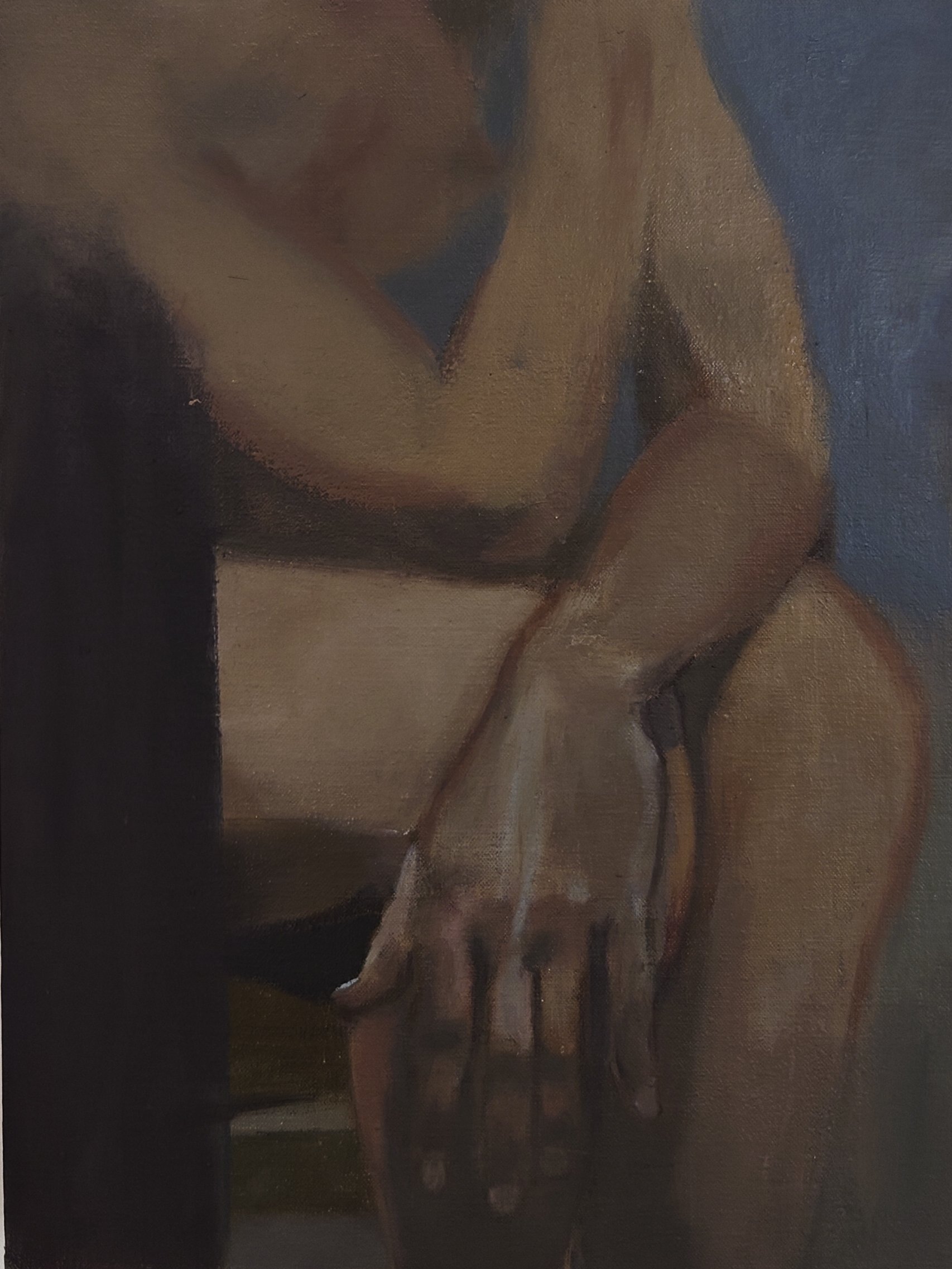
263. Luna (hand), 2026, Öl auf Leinwand, 40 × 30cm
This is the last painting from the visit to Rome, and it reminds me how much there is to gain from attending a life model painting session. You can probably tell the session was not set up by me, because the pose was unusually challenging. When I work with a model, I usually make things a little easier for myself, choosing simpler poses, or sometimes no fixed pose at all. This one asked much more of me. I enjoyed looking closely and trying to follow the complicated ways the body folds, presses, and meets itself. I could probably spend another few years on it, though I might need to enter a monastery to find that much time and concentration.
That feeling of being opened up by an artwork takes me back to 1997, when I was seventeen and had just moved out of home. My girlfriend at the time gave me Slaughterhouse-Five by Kurt Vonnegut and a CD by the Melbourne electronic band Clan Analogue. Listening to the minimal glitch techno of the late 1990s while reading Vonnegut’s strange, generous, otherworldly fiction opened up my world in a way I still remember clearly. Her sister was a curator at PS1, the experimental branch of the Museum of Modern Art in New York, and although I never went looking for that world directly, people somehow placed wonderful artistic resources into my hands and invited me into conversation with them. Growing up in Perth, I often felt removed from the center of things, but through those encounters I began to see culture as something alive and restless, and cultural institutions as real and imagined places where different ideas about life, and how to live it, could be explored.
My own small brush with being shown in a museum came in 2014, in an exhibition at the Perth Institute of Contemporary Art with a group of artists working in minimalist ways. Some of my favorite Perth painters were included, which made it especially meaningful to be part of it. No curators have been in touch with me since then, but that does not really matter. After a while, you can look at a painting of your own and feel it begin to speak in its own strange voice: “We will take a vaporetto to the far bank, where, in the haze, an event—a messy artwork—is being produced. There is a lot happening over there. Come this way. Sit in the cool twilight of this smoky corner café. Push through the intellectuals. It is the 1920s, and they have no idea what is coming. What a moment. Step around the couple making out at the bar. Whew. What a fever dream. The roaring twenties. Shapes and colours—look. Come closer. Can you feel that?” That is the imagination at work. Sensation is what I am talking about: the feeling that travels across different modes of art and keeps them alive.