259. Figure after Degas (Figur nach Degas) (2)
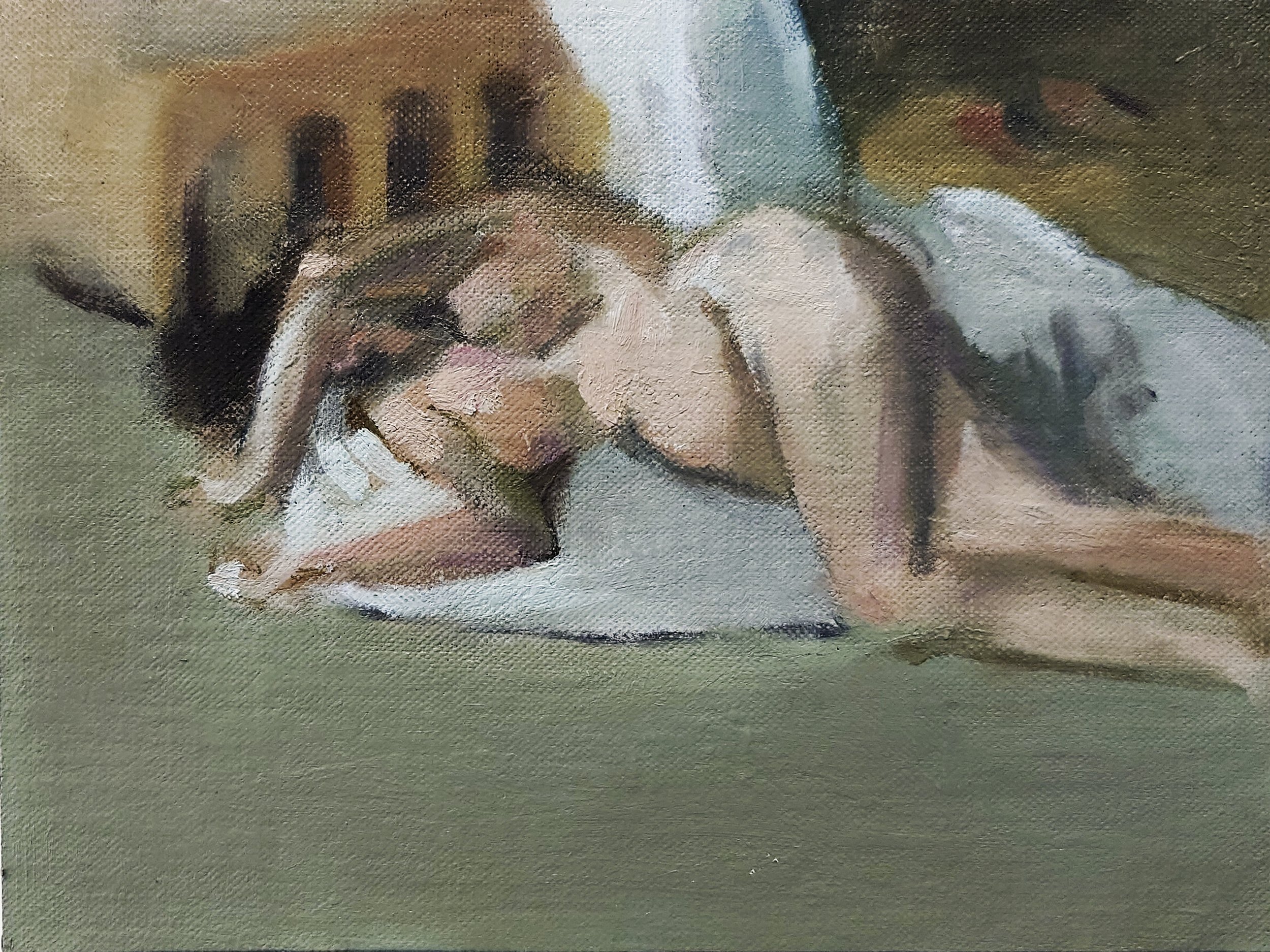
259. Figure after Degas (Figur nach Degas), 2026, Öl auf Leinwand, 20 × 15cm, (Thomas Ansted)
My studio is in a space that used to be a wool and knitting shop. The shop has since moved to a larger premises on the nearby market square. When I took over the space, it was empty, but I removed many of the remaining fittings, pulling out shelves to expose the walls. Apart from the occasional knitting needle or stray ball of wool that had fallen behind the old shelving, I did not think much about the building’s former life. I certainly never imagined I would end up making work in what had once been a knitting shop. I am not knitting, of course, but I do paint in a way that loops back and forth, almost like a knitting motion. I am not sure this is the best way to paint. It is more tortoise than hare. Sometimes painting seems better suited to a constant forward drive, especially at the beginning, when the main thing is to keep moving rather than agonise over what may already be fundamentally flawed. There is something faintly absurd about tying every stitch together, numbering every resolved painting, and writing a blog entry for each one. Still, I keep returning to the feeling that it is better to work through strange and awkward material than to simply produce something polished, beautiful, and formulaic.
When I was recently in Australia, I threw out some old belongings from my family home, including articles I had printed while writing my thesis. One of them was Adorno’s essay What Does It Mean to Come to Terms with the Past? The irony of finally discarding it was hard to miss. I finished that thesis 16 years ago, yet I had always found it difficult to let go of essays that had felt important along the way. An entire degree could be built around that one text, and no doubt sometimes has been. Now, so much of the labour once tied to printing, reading, and essay-writing seems to be slipping toward artificial intelligence—toward a kind of prosthetic thought. Perhaps that is simply the direction things are taking. Even so, any student of 20th-century German art still faces work that cannot be automated.
I was preoccupied with these questions in my twenties: how do you resolve the relationship between aesthetics and ethics? Few places show more clearly than Germany how disastrously that dance can go wrong. Twentieth-century German art is difficult terrain, but it is also exhilarating to study, with its extreme highs and lows. Out of that wreckage, humanity turned back in disbelief, and some of what emerged helped shape the safeguards of civil society. It is a little like the way an aircraft model may be redesigned after a crash to make the next one safer. On the one hand, this knitting tendency turns a string of voids into a net. On the other, art remains a slippery fish.